Marketing to CISOs vs CFOs
One of the most common reasons cybersecurity deals stall isn’t budget.
It’s misalignment.
Specifically, misalignment between the people evaluating the solution and the people approving the investment.
Security vendors often focus heavily on the technical buyer — usually the CISO or security leadership.
But most enterprise security decisions don’t end there.
They move upward.
Eventually, the conversation reaches the CFO.
And what resonates with one rarely works with the other.
Understanding how to speak to both is essential if you want to move deals forward.
CISOs and CFOs Are Solving Different Problems
At first glance, both stakeholders care about security.
But they care about it for very different reasons.
A CISO is responsible for:
Reducing exposure
Preventing incidents
Ensuring resilience
Their mindset is operational.
They are thinking about:
Threats
Controls
Coverage
Capability
A CFO is responsible for:
Protecting financial stability
Managing risk
Justifying investment
Their mindset is commercial.
They are thinking about:
Cost
Impact
Trade-offs
Return
Both want protection — but they define value differently.
What CISOs Care About
When marketing to CISOs, the conversation tends to focus on:
Effectiveness
Coverage
Integration
Operational fit
They want to know:
Will this reduce our attack surface?
Will this improve our detection capability?
Will this integrate with what we already have?
Technical depth matters here.
But so does practicality.
CISOs are not just buying tools.
They are buying:
Confidence
Control
Clarity
They need to feel that the solution improves their ability to manage risk day-to-day.
What CFOs Care About
When selling cybersecurity to a CFO, the conversation changes.
They are not asking:
“How does this work?”
They are asking:
“What does this mean for the business?”
The focus shifts to:
Financial exposure
Operational disruption
Regulatory risk
Instead of threat reduction, they care about:
Loss avoidance
Business continuity
Investment justification
A CFO doesn’t need to understand how detection works.
They need to understand:
What happens if we don’t act?
The Language Needs to Change
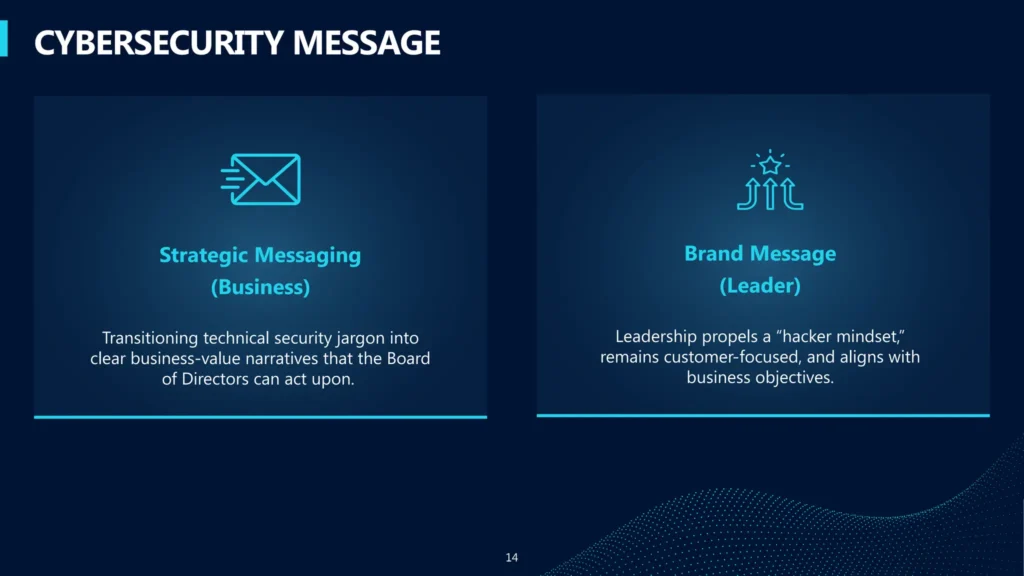
Security messaging often stays technical for too long.
That works with CISOs.
But it doesn’t travel upward.
For example:
A CISO may respond to:
“Improved endpoint visibility”
A CFO is more likely to engage with:
“Reduced operational disruption risk”
The capability hasn’t changed.
The framing has.
When cybersecurity is explained in business terms, it becomes easier to support internally.
The Risk vs Cost Conversation
CISOs often lead with risk.
CFOs evaluate cost against impact.
Which means security must be positioned not as:
An IT upgrade
But as:
A risk management decision.
The conversation shifts from:
“How much does this cost?”
to:
“What does this protect us from?”
This is where alignment happens.
Why Deals Stall
Many cybersecurity deals gain strong technical support.
But fail to progress.
Not because the solution is wrong — but because the business case isn’t clear.
If the CFO cannot see:
Financial impact
Operational protection
Governance alignment
Momentum slows.
The technical case may be strong.
But the commercial case is missing.
Bridging the Gap
Security vendors that succeed across cybersecurity decision makers do one thing well:
They translate.
They help CISOs articulate:
Business risk
Operational exposure
Financial implications
This enables internal alignment.
And alignment accelerates decisions.
Practical Approach
When marketing to CISOs:
Focus on control, coverage and resilience.
When selling cybersecurity to CFOs:
Focus on continuity, liability and exposure.
Both conversations are about protection.
But they sit in different contexts.
Final Thought
Cybersecurity decisions rarely live in one department.
They move from technical evaluation to financial approval.
Understanding how to engage both CISOs and CFOs is not just a messaging exercise.
It’s a deal progression strategy.
Because in cybersecurity, alignment between decision makers often determines whether opportunities move forward — or stall.