
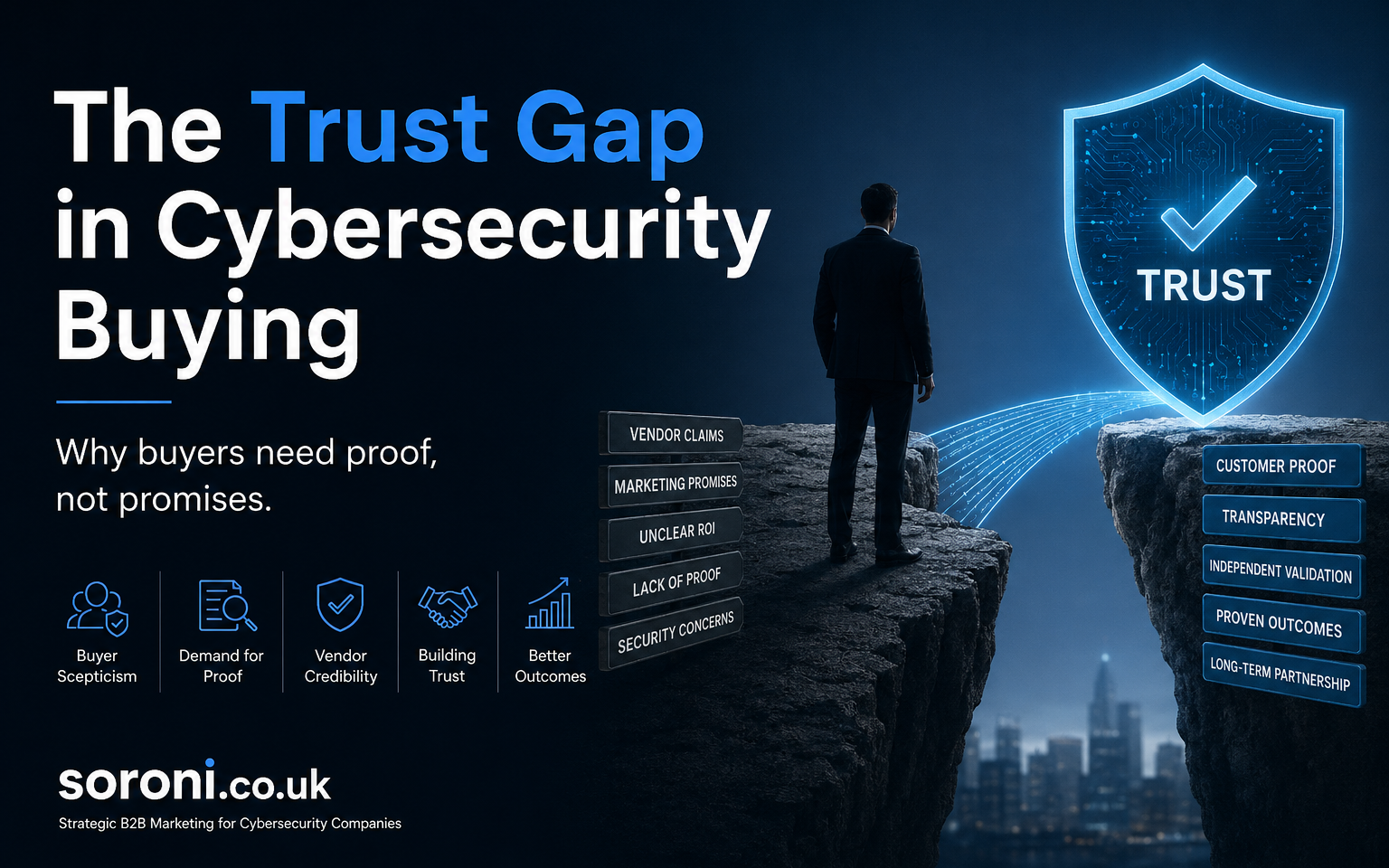
The Trust Gap in Cybersecurity Buying
Cybersecurity has a unique challenge that most industries don’t face.
The very companies tasked with protecting organisations from risk are often viewed with significant scepticism by the people buying their solutions. While technology buyers in other sectors compare features, pricing, and functionality, cybersecurity buyers start with a different question:
“Can we trust this vendor?”
That question has become increasingly important as cyberattacks grow more sophisticated, regulations become stricter, and security budgets face greater scrutiny from boards and executive teams.
There’s a moment every cybersecurity vendor knows well. A qualified prospect downloads your content, visits your pricing page, maybe attends a webinar. And then — nothing. They go quiet. They don’t reply to follow-up. They didn’t go to a competitor. They just stopped.
This isn’t a leads problem. It’s not a sales problem. It’s a trust problem.
In cybersecurity, the gap between a prospect recognising they have a need and being willing to enter a sales conversation is wider than in almost any other B2B category. Understanding why that gap exists — and what it takes to close it — is one of the most important strategic questions a cybersecurity vendor can answer.
Why Cybersecurity Buyers Are Naturally Sceptical
Unlike most technology purchases, cybersecurity decisions carry significant personal and organisational risk.
If a CRM implementation fails, productivity may suffer. If a cybersecurity solution fails, organisations face data breaches, regulatory fines, operational disruption, reputational damage, and board-level scrutiny.
As a result, buyers are conditioned to challenge vendor claims. They question:
- Can this vendor actually deliver what they promise?
- Have they solved this problem before?
- How secure is the vendor itself?
- What happens when something goes wrong?
- Are their claims backed by evidence?
This scepticism isn’t irrational. It’s a reflection of the high stakes involved — and it’s compounded by the fact that the stakes are personal as well as organisational. A cybersecurity purchase is also a career decision. If a CISO selects a vendor and a breach occurs, the question isn’t just “why did this happen?” — it’s “why did you choose them?” Buyers are protecting themselves as much as they’re protecting their organisation. That means they move slowly, demand more evidence, and are highly sensitive to anything that feels like over-promising.
The Problem with Traditional Cybersecurity Marketing
Many cybersecurity vendors still rely heavily on product-centric messaging:
- AI-powered detection
- Best-in-class protection
- Industry-leading threat intelligence
- Next-generation security
The problem is that every vendor makes similar claims. When buyers encounter dozens of companies all claiming to be the most advanced, differentiation disappears. Trust doesn’t come from marketing language. Trust comes from evidence.
Much of what cybersecurity vendors invest in — lead generation, ad spend, event presence, outbound sequences — can actually make the trust gap worse if the underlying messaging isn’t doing the right job.
Pushing demos too early is a common culprit. When a buyer is in early-stage research, asking them to book a demo is asking them to expose their interest to a sales team before they’ve built any internal confidence in the vendor. Most buyers won’t do it. Aggressive demo CTAs signal that you care more about pipeline velocity than the buyer’s process — and that erodes trust immediately.
Feature-led content that doesn’t address risk is another. White papers describing product capability are useful for technical evaluators. They don’t build trust with the buying committee. Trust at committee level is built by demonstrating you understand their risk environment, their regulatory pressure, and the business outcomes they’re accountable for. If your content speaks fluent technology but not fluent business risk, the CFO and board sponsor will never reach the confidence needed to move forward.
The Buying Committee Doesn’t Agree on What Trust Looks Like
There’s an additional layer of complexity that most cybersecurity marketing ignores.
The CISO and CFO have fundamentally different buying criteria. A CISO builds trust through technical depth — architecture documentation, threat intelligence methodology, integration capability. A CFO builds trust through commercial clarity — case studies, ROI models, pricing transparency. Marketing that earns trust with one audience often fails to earn it with the other.
The result is a buying committee where one stakeholder is ready and the other is not, and nothing moves forward. A homepage that tries to speak to all of them simultaneously ends up connecting with none of them. The most effective cybersecurity vendors design deliberate pathways for each audience — separate landing pages, audience-specific messaging tracks, clear navigation that serves the CISO, the CFO, and the compliance lead each on their own terms.
The Stages of Trust in the Cybersecurity Buying Journey
Trust in cybersecurity doesn’t arrive all at once. It builds in stages — and vendors who understand those stages can design their marketing and sales motion to accelerate each one.
Stage 1: Credibility trust. “This vendor is a legitimate business with relevant expertise.” Earned through brand presence, third-party recognition, industry certifications, and basic social proof. Without it, a buyer won’t engage with your content at all.
Stage 2: Relevance trust. “This vendor understands my specific situation.” Earned through precise positioning — messaging that reflects the buyer’s industry, regulatory environment, organisational size, and the specific threat landscape they’re navigating. Generic messaging fails here.
Stage 3: Evidence trust. “This vendor has solved problems like mine for organisations like mine.” This is where case studies, references, and quantified outcomes do their work. It’s the most powerful form of trust — and the hardest to build. It requires real clients willing to be named, real outcomes that can be measured, and real specificity about the context in which you delivered results.
Stage 4: Relationship trust. “I personally trust the people at this vendor.” Built through direct interaction — conversations, content engagement, events, and the quality of the sales relationship itself. It’s the final stage before a deal progresses, and it’s a key reason cybersecurity sales cycles are so long. Buyers want to know the humans behind the product before committing to a partnership that may involve responding to a breach at 2am.
The mistake most vendors make is investing heavily in Stage 1 while neglecting Stages 2 and 3 — or jumping straight to Stage 4 before the foundation has been built. You cannot build relationship trust on a base of weak relevance and thin evidence.
How Security Vendors Can Close the Trust Gap
1. Lead with customer evidence
Case studies remain one of the most effective trust-building assets in cybersecurity. A detailed customer success story often carries more weight than dozens of product claims.
But most cybersecurity case studies don’t do enough work. To be genuinely effective, a case study needs to: identify the buyer type clearly, describe the risk environment they were in, explain what they were trying to achieve, show what happened, and quantify the outcome in business terms — not technical metrics.
“We reduced detection time by 60%” is interesting. “We helped a regional bank meet NIS2 requirements, reduce SOC analyst workload by 40%, and avoid two potential regulatory interventions in the first year” is a trust-builder.
❌ “Trusted by 500+ companies worldwide” ✓ Named case study: 40% reduction in incident response time for a regulated financial services firm
2. Show how you think
Many cybersecurity companies hide their expertise behind gated content and sales conversations. The strongest brands do the opposite — openly sharing technical insights, industry analysis, research findings, and security best practices. When buyers consistently learn from your content, trust develops naturally. This matters most when marketing to senior security leaders who are evaluating whether you genuinely understand their world.
3. Be transparent about limitations
Counterintuitively, admitting limitations often increases trust. No solution prevents every attack. No platform solves every challenge. Buyers appreciate vendors who clearly explain what they do well, what they don’t do, and who they are not the right fit for. Transparency signals maturity and credibility — and in a market full of over-claiming, it stands out.
4. Make trust visible
Trust should be demonstrated, not claimed. Verifiable evidence of security maturity is among the strongest drivers of buyer confidence:
- Certifications and independent audits
- Security assessments and trust centres
- Vulnerability disclosure programmes
- Compliance framework alignment (NIS2, ISO 27001, Cyber Essentials)
- Analyst recognition and third-party validation
If your website isn’t surfacing these signals prominently, you are invisible to a significant portion of your addressable market — particularly the growing cohort of regulation-driven buyers searching for vendors who speak their compliance language.
5. Give buyers something valuable before asking for anything
The buyers doing the most thorough research — the ones most likely to become your best clients — will not engage with a vendor who offers nothing before asking for their time. A benchmark tool, a compliance gap assessment, a guide to structuring an internal business case — these create reciprocity and position you as a trusted advisor before the first sales conversation happens.
❌ “Book a demo” as the only CTA ✓ “Download: The CISO’s Guide to Evaluating Identity Security Vendors”
6. Connect your trust-building content to your CRM
Every piece of content a buyer engages with is a signal. Which topics are they reading? Which compliance frameworks are they researching? What stage of the journey does their behaviour suggest? If that signal data isn’t being captured and used by your sales team, you’re generating heat and losing it.
A properly configured CRM and marketing automation system turns trust-building content into pipeline intelligence — so when a sales conversation does begin, it starts from a position of demonstrated relevance rather than cold introduction. An inbound marketing strategy that maps content to buyer stages and feeds intent data into your CRM is what separates vendors who generate pipeline from those who simply generate traffic.
Trust Is the New Competitive Advantage
The cybersecurity market is crowded. New vendors emerge every month. Features are increasingly similar. AI capabilities are rapidly becoming table stakes.
Trust is becoming the true differentiator.
The vendors that succeed won’t necessarily be those with the loudest marketing or the longest feature list. They’ll be the organisations that consistently provide evidence, transparency, and credibility throughout the buying journey — understanding, as we’ve explored in the cybersecurity buyer journey, that buyers complete most of their evaluation long before speaking to sales.
By the time a prospect books a meeting, they have already read your website, reviewed your content, compared competitors, looked for customer feedback, searched for analyst opinions, and evaluated independent validation. Trust must be built before the sales conversation begins — not during it.
Final Thoughts
Many cybersecurity companies believe they have a lead generation problem. In reality, they often have a trust problem.
Traffic alone doesn’t create pipeline. Proof does.
In cybersecurity, buyers don’t purchase products first. They purchase trust. And only then do they purchase technology.
If your marketing isn’t helping buyers independently validate your expertise, credibility, and outcomes, you’re likely losing opportunities long before your sales team gets involved. The future of cybersecurity marketing belongs to vendors who replace promises with proof — and make trust their strongest competitive advantage.
Related Resources
- Why Cybersecurity Sales Cycles Are So Long
- Cybersecurity Buyer Journey Explained
- Cybersecurity Marketing vs SaaS Marketing: Key Differences Explained
- Cybersecurity Go-To-Market Strategy
We work with cybersecurity companies, MSSPs, and SaaS security vendors to build demand generation and content systems designed around the way security buyers actually buy. Let’s talk about your pipeline →