Cybersecurity Marketing vs SaaS Marketing: Key Differences Explained
At first glance, cybersecurity companies often look like SaaS businesses.
They sell software.
They operate on subscriptions.
They rely on demos, trials and sales teams.
So naturally, many cybersecurity firms adopt SaaS marketing playbooks.
Product-led funnels.
Feature-led messaging.
Free trials.
Automated nurture sequences.
And yet — growth stalls.
Pipeline becomes unpredictable.
Deals take forever to close.
Conversion rates remain low.
Because cybersecurity is not SaaS.
Not commercially.
Not psychologically.
Not operationally.
Understanding this difference is the first step toward building a marketing strategy that actually works for security companies.
The Core Difference: SaaS Sells Productivity. Cybersecurity Sells Risk Reduction.
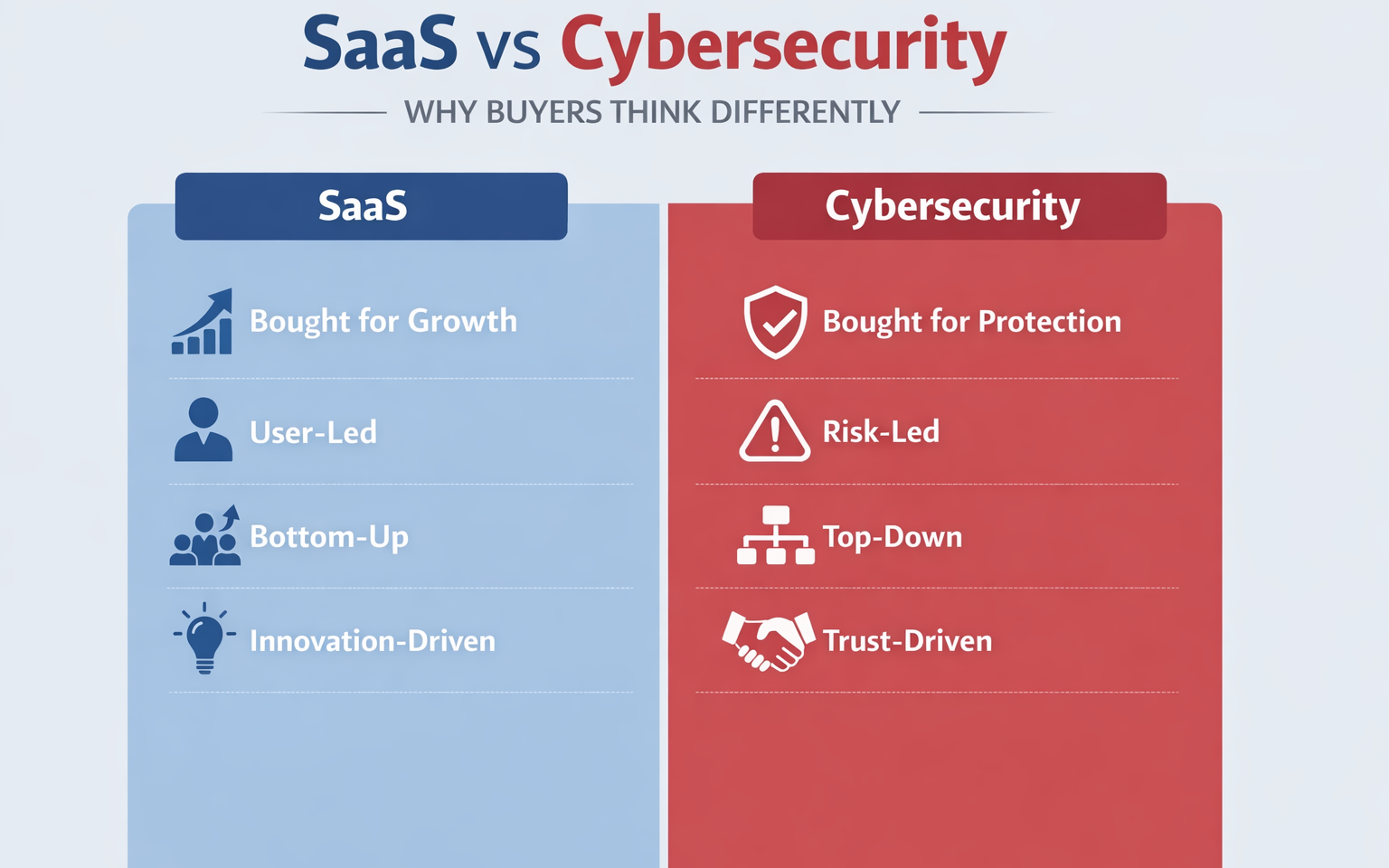
SaaS marketing is built around:
→ Efficiency
→ Cost savings
→ Growth enablement
Cybersecurity Go-To-Market Strategy is built around:
→ Fear
→ Trust
→ Responsibility
SaaS buyers ask:
“Will this help us move faster?”
Cybersecurity buyers ask:
“Will this protect us from failure?”
That emotional shift changes everything.
You are not selling upside.
You are selling downside protection.
This means:
Cybersecurity is bought under pressure.
SaaS is bought under ambition.
SaaS is Feature-Led. Cybersecurity is Trust-Led.
SaaS marketing wins through:
✔ UI
✔ Speed
✔ Integrations
✔ Automation
Cybersecurity wins through:
✔ Credibility
✔ Proof
✔ Assurance
✔ Outcomes
In SaaS:
Features drive conversion.
In cybersecurity:
Trust drives conversion.
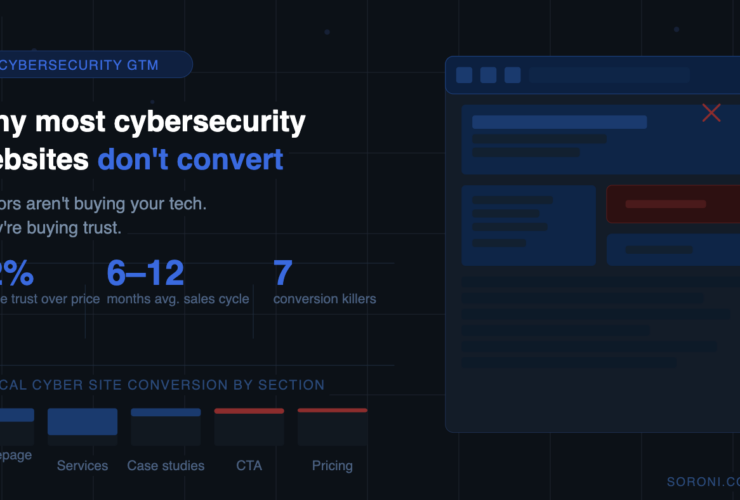
This is why many cybersecurity websites fail — they look like SaaS sites:
Screenshots
Feature grids
Technical jargon
But enterprise buyers don’t buy security because of dashboards.
They buy because they believe:
“This vendor will protect us when it matters.”
The Buying Journey is Completely Different
SaaS buying is often:
→ Department-led
→ Budget-driven
→ Bottom-up
Cybersecurity buying is:
→ Multi-stakeholder
→ Risk-driven
→ Top-down
A SaaS deal might involve:
Head of Marketing
Operations
IT
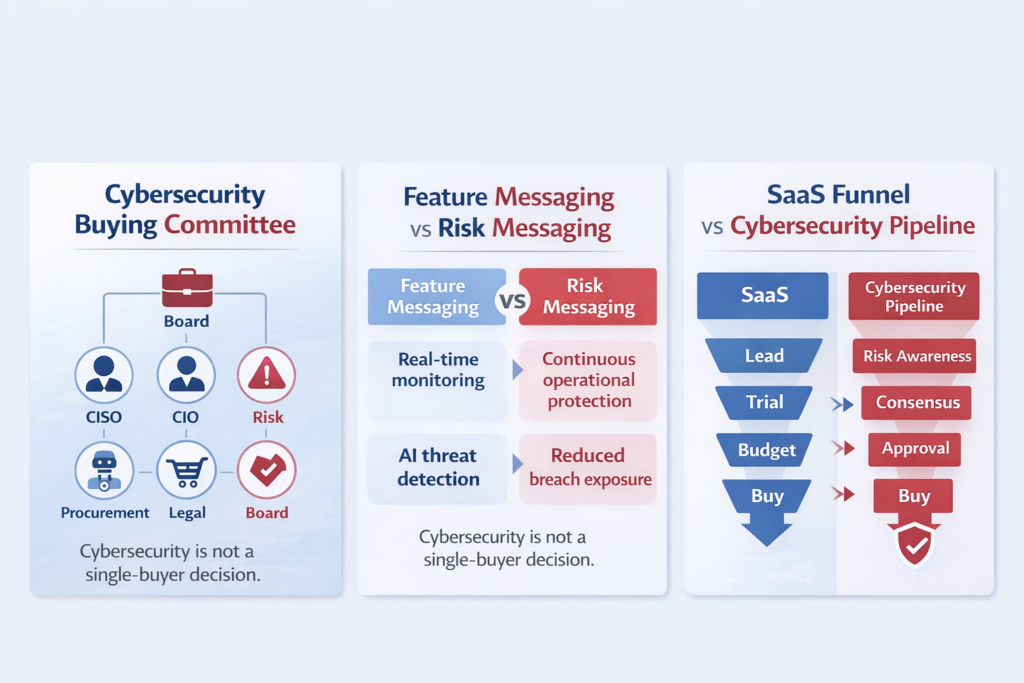
A cybersecurity deal may involve:
CISO
CIO
Risk team
Procurement
Legal
Board
You’re not convincing one buyer.
You’re aligning an organisation around perceived risk.
That’s why cybersecurity sales cycles are longer.
And why marketing must support consensus creation, not just demand generation.
Cybersecurity Buyers Don’t Want Innovation. They Want Assurance.
In SaaS, innovation sells.
“AI-powered”
“Next-gen”
“Disruptive”
In cybersecurity, innovation can actually create hesitation.
Because innovation introduces uncertainty.
Security buyers want:
Stability
Reliability
Maturity
The safest choice often wins — not the most advanced.
This flips traditional SaaS positioning on its head.
The Outcome is Different
SaaS delivers visible impact.
More leads.
Better collaboration.
Faster workflows.
Cybersecurity delivers invisible success.
Nothing happens.
No breach.
No incident.
No crisis.
You are selling an absence of failure.
That makes storytelling harder — and proof more important.
Case studies matter more in cybersecurity than in SaaS because they demonstrate:
Survival
Resilience
Trustworthiness
Marketing Metrics Should Be Different
SaaS marketing optimises for:
✔ Trial sign-ups
✔ Activation
✔ Product usage
Cybersecurity marketing should optimise for:
✔ Stakeholder alignment
✔ Deal progression
✔ Trust signals
Pipeline quality matters more than volume.
Because security deals are:
High value
High complexity
High scrutiny
A thousand MQLs mean nothing if they lack organisational authority.
Messaging Must Be Board-Relevant
SaaS messaging often speaks to users.
Cybersecurity messaging must speak to:
Risk owners
Executives
Boards
Which means shifting from:
Technical language → Business impact
Instead of:
“Advanced endpoint detection”
Say:
“Reduced operational risk exposure”
Instead of:
“Real-time monitoring”
Say:
“Continuous business protection”
Security is no longer an IT issue.
It’s a business liability issue.
Compliance Changes the Game
SaaS marketing is often discretionary.
Cybersecurity is increasingly:
Regulation-driven
Insurance-driven
Governance-driven
Frameworks like ISO, NIS2 and emerging AI risk expectations mean security purchases are becoming:
Mandatory
Time-sensitive
Board-visible
This creates a different demand dynamic.
Security isn’t always bought because someone wants it.
It’s bought because someone must.
CRM Should Reflect This Reality
Many cybersecurity firms implement CRM systems using SaaS assumptions.
This leads to:
Linear pipelines
Single buyer journeys
Feature-based deal stages
But cybersecurity deals move through:
Risk validation
Consensus building
Budget justification
Compliance alignment
Which means CRM should track:
Stakeholders
Risk triggers
Buying committees
Not just leads.
What Cybersecurity Marketing Should Do Instead
To succeed, cybersecurity marketing must:
→ Lead with trust, not features
→ Speak to risk, not productivity
→ Enable consensus, not just demand
→ Align to compliance drivers
→ Support complex deal journeys
The goal is not:
More leads.
The goal is:
More confidence in buying.
Final Thought
Cybersecurity companies that adopt SaaS marketing playbooks often struggle.
Not because they lack capability.
But because they are selling something fundamentally different.
SaaS sells improvement.
Cybersecurity sells protection.
And protection is bought differently.
Companies that adapt their marketing to reflect this reality build:Stronger positioning
Shorter sales cycles
More predictable pipeline